Physiotherapy or Chiropractic Care for Carpal Tunnel: A Thorough Comparison

Carpal tunnel syndrome (CTS) is on the rise in this age of remote work and nonstop digital device use. The constant repetitive hand movements, overuse of phones or poor home ergonomics are often the most common causes of CTS. It occurs when the median nerve is compressed/pinched while passing through the wrist. The median nerve is responsible for sensations to your thumb, index, middle and half of your ring finger. When compressed, it can lead to tingling sensations in fingers, wrist pain and weakness in hands. But don’t worry; getting help early provides relief and can prevent the condition from worsening. Physiotherapy and chiropractic care are usually the first lines of treatment recommended to manage the condition. Which one is right for you? This blog discusses the role of these two non-surgical paths and the common confusion patients face when choosing a starting point.
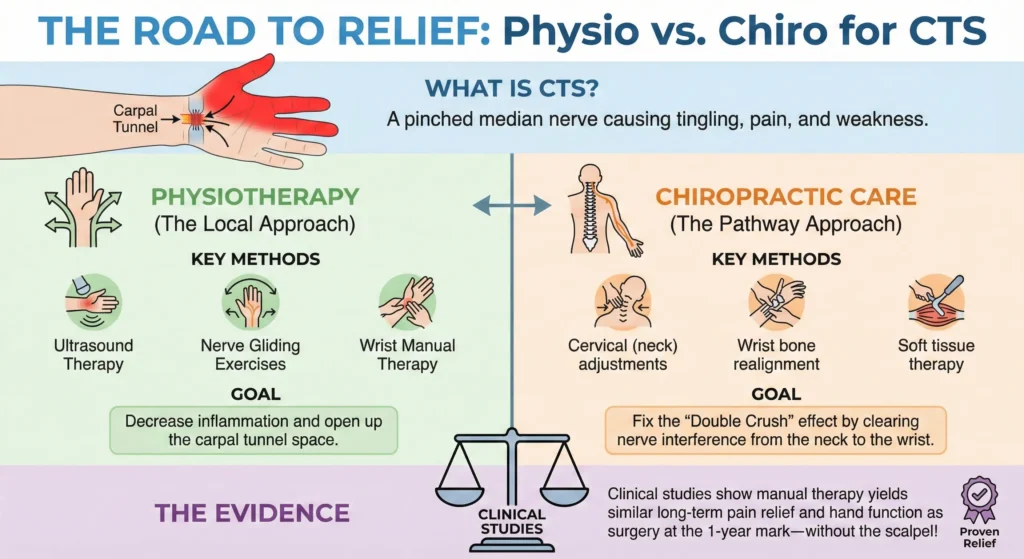
Physiotherapy Approach for Carpal Tunnel Syndrome Treatment
CTS is an entrapment neuropathy where your wrists become a pressure trap. Swollen tendons and a rigid carpal tunnel end up pinching the median nerve passing through the wrist.
Physiotherapy adopts a multifaceted approach to treat carpal tunnel syndrome, combining exercises, manual therapy and other non-invasive modalities. The tailored treatment plan addresses the root cause of your carpal tunnel syndrome, preventing further complications.
What are the Physiotherapy Methods for CTS?
The following is a general list of methods physios generally use for CTS management. Your physiotherapist may recommend some or all of them, depending on your unique symptoms, medical history, lifestyle and recovery needs.
Stretching & Strengthening Exercises
Exercises help create space in the carpal tunnel to relieve pressure on the median nerve. Stretching increases the flexibility of ligaments and tendons that pass through your wrist. This helps prevent them from becoming tight or inflamed, which would further crowd the nerve and aggravate your symptoms.
Tendon & Nerve Gliding Exercises
These are specialized stretches that help the median nerve glide through the carpal tunnel smoothly without getting compressed. Your physical therapist guides you through the exercises to ensure that the tendons in your hand move independently and pain-free. There are also wrist flexor/extensor stretches that help maintain the length of forearm muscles, reducing strain on your wrist joint.
Manual Therapy
Manual therapy is a hands-on treatment commonly used in physiotherapy for carpal tunnel treatment. For CTS, manual therapy focuses on three crucial areas: Neurodynamic Mobilization, Soft Tissue Mobilization & Myofascial Release and Joint Mobilization. The therapist gently guides your arm, wrist, and neck through specific sequences to move the median nerve. In soft tissue mobilization, the therapist applies sustained pressure to the affected muscles of your forearm and palm to create more space in the carpal tunnel and let the median nerve glide smoothly.
Ultrasound Therapy
Ultrasound Therapy (also known as therapeutic ultrasound) is a non-invasive physical therapy used to reduce inflammation and promote nerve healing in CTS. This therapy uses sound waves to generate gentle heat within the carpal tunnel. On doing so, the blood flow increases, which in turn delivers oxygen and nutrients to the nerve and helps relax tight ligaments.
Education
Patient education is the most critical part of physiotherapy treatment for carpal tunnel syndrome. Your physiotherapist guides you through three main pillars of recovery: Risk Awareness, Ergonomics, and Self-Management. They help you understand CTS and how it often arises from postural or repetitive strains in the workplace. They help you identify the triggers in daily life that may aggravate the symptoms and teach you how to avoid them, whether at the office or at home, so you can protect your wrist from further damage.
Exercises are the foundation of a typical physiotherapy treatment plan for CTS. But you should always perform the exercises after consulting with your physiotherapist in Brampton or near your location. Physiotherapists and occupational therapists are trained professionals who diagnose the core of the problem and prescribe the right exercises accordingly.
How Physiotherapy Helps with Carpal Tunnel Syndrome?
Physiotherapy addresses carpal tunnel syndrome from three angles: mechanical, inflammatory, and behavioural. It focuses on creating more space in the carpal tunnel, calming the swelling of tendons and finally stops the cause of CTS. Here’s how physiotherapy helps with CTS treatment:
Non-Invasive Pressure Management
In CTS, the tissues and tendons swell up inside the carpal tunnel, which is already a narrow passageway in your wrist. The swollen tissues compress the median nerve, resulting in CTS symptoms. Physiotherapy focuses on physically “opening” that space without a scalpel, giving the nerve more breathing room.
Restoration of Nerve Mobility
Nerves are meant to slide and stretch as we move. In CTS, the median nerve can become stuck to surrounding inflamed tendons. Physiotherapy teaches you specific movements that restore the mobility of your median nerve through the tunnel.
Postural Correction
Numbness in the hand doesn’t always start at the wrist. Sometimes the nerve is pinched at the neck or shoulder as well. So, a physiotherapist assesses your entire “nerve pathway” to ensure the nerve isn’t being compressed at its source in the spine. This prevents the recurrence of symptoms and promotes long-term recovery.
Muscle Strengthening
Once inflammation is controlled, physiotherapy restores grip and pinch strength. You learn how to use your hands in a “neutral” position, reducing the mechanical stress that caused the issue in the first place.
Chiropractic Approach for Carpal Tunnel Syndrome
Physiotherapy primarily focuses on the local mechanics of the wrist. Chiropractic care, on the other hand, looks at the entire pathway of the median nerve. The median nerve doesn’t start at your wrist. It begins as a bundle of nerve roots exiting your cervical spine (neck). If a nerve is slightly pinched or “irritated” at the neck, it becomes significantly more vulnerable to being compressed at the wrist. So, a chiropractor identifies and removes any “interference” at the neck to ensure that the nerve is healthy enough to handle the normal pressures at the wrist without causing symptoms.
What Are the Chiropractic Techniques for CTS?
Chiropractic methods primarily focus on realigning the spine and improving the nervous system. Doing so helps relieve pressure on the median nerve, further alleviating the symptoms of carpal tunnel syndrome. Here are the common chiropractic methods often involved in treating CTS.
Spinal & Cervical Adjustment
The chiropractor performs precise, quick thrusts to the cervical (neck) vertebrae, which is also the origin of the median nerve. The adjustments fix the subluxations in the spine that may be irritating the nerve roots.
Wrist Adjustments
Chiropractors can also perform extremity adjustments for the eight small carpal bones in the wrist. This adjustment ensures that the carpal bones are placed correctly. Over time, repetitive stress can cause these tiny bones to shift, which physically narrows the carpal tunnel. Adjusting the bones, however, widens the tunnel and takes physical pressure off the median nerve.
Soft Tissue Therapy
This therapy addresses the scarred muscles, tendons and fascia around the nerve. Techniques like Active Release Technique (ART) or Graston Technique (using a smooth metal tool) are used to “break up” these adhesions, which otherwise cause the median nerve to get stuck to the surrounding tendons.
Chiropractic care offers non-invasive and natural ways to manage carpal tunnel syndrome. However, it depends on your individual symptoms. Chiropractic care is mostly effective when the symptoms are caused by poor posture or repetitive hand use.
How Chiropractors Help with Carpal Tunnel Syndrome?
Chiropractic care can be a part of your treatment for carpal tunnel, along with physiotherapy, based on what your body needs to heal completely. The healthcare professional diagnoses the root cause and prescribes effective therapies accordingly. The benefits of chiropractic treatment are:
Addresses The “Double Crush” Effect
Many people with CTS also have nerve irritation in their neck due to poor posture (“tech neck”). Chiropractic adjustments ensure that the nerve isn’t being “pre-pinched” at the spine, which makes the wrist symptoms much easier to manage.
Restores Wrist Alignment
Manual wrist adjustments help realign the carpal bones in the carpal tunnel. It physically widens the tunnel and provides immediate decompression for the median nerve without surgery.
Improves the Nervous System’s Ability
Chiropractic care removes mechanical obstructions at the spine and wrist. This improves nerve conduction velocity (the speed at which signals travel to your hand), which can reduce that “dead” or heavy feeling in the fingers.
Corrects Posture
Chiropractors strengthen and realign the mid-back, preventing the slumped posture that often leads to CTS flare-ups. Posture correction provides a long-term preventative solution rather than just a temporary fix.
Physiotherapy vs Chiropractic Care for CTS: Clinical Evidence
According to research, women treated with manual therapy reported better functional improvement and grip strength at the 1-month mark compared to a surgery group. After one year, the outcomes for pain relief and hand function were virtually identical between those who had surgery and those who had manual therapy.
Recent clinical trials (including studies from 2024–2025) consistently show that ultrasound therapy is a strong option for mild to moderate CTS. Studies have shown ultrasound can significantly reduce Visual Analogue Scale (VAS) pain scores (e.g., dropping from a 7/10 to a 3/10 over a 4-week course). Unlike some other conservative treatments, ultrasound has been shown to improve nerve conduction velocity, meaning the nerve actually starts “firing” faster and more efficiently.
A landmark long-term study (often cited in 2024 updates of the Journal of Orthopedic & Sports Physical Therapy) followed patients over several years. It found that manual therapy (including desensitization of the central nervous system) resulted in similar improvements in self-reported function and pain as surgery at the 12-month and 4-year marks. Research shows that physiotherapy patients often experience faster short-term relief (within the first 4 weeks) compared to surgical patients.
Clinical trials investigating “Double Crush” (nerve irritation at both the neck and wrist) have shown that patients receiving cervical spine manipulation alongside wrist treatment reported significantly higher satisfaction and lower pain scores than those receiving wrist-only treatment. Research published in the Journal of Manipulative and Physiological Therapeutics found that chiropractic care was equally effective as medical treatment (ibuprofen and bracing) for CTS, with the added benefit of avoiding pharmaceutical side effects.
Conclusion
Carpal tunnel syndrome can be a debilitating experience in your daily life. But it doesn’t have to be permanent. Identify the signs and consult with a physiotherapist/doctor/occupational therapist as early as possible. Both physiotherapists and chiropractors are trained to relieve pressure on the median nerve and treat the symptoms of CTS. Physios may recommend chiropractic care as a part of your treatment plan if the root cause is related to the spinal/cervical alignment. Are you experiencing tingling sensations or pain in your wrist? Do not worry. Book an appointment with the nearest physiotherapist and begin the treatment.
About Author

Blog Categories
- Acupuncture Treatment (10)
- Ankle Sprain (1)
- Arthritis Treatment (1)
- Back Pain (23)
- carpal tunnel (2)
- Chiropractic Care (40)
- Tennis Elbow (1)
- Chronic Pain (7)
- COVID-19 (1)
- Custom Orthotics (6)
- Dizziness (4)
- Exercises (14)
- Foot Orthotics (6)
- Hamstring Stretches (2)
- Info Articles (3)
- Kids Injury (1)
- Laser Therapy (4)
- Massage Therapy (21)
- Neck Pain (18)
- Orthopedic (1)
- Osteoarthritis (6)
- Osteopathy (3)
- Pain Management (25)
- Physiotherapy Benefits (47)
- Physiotherapy Clinic (6)
- Physiotherapy Exercises (13)
- Physiotherapy Tips (25)
- Physiotherapy Treatment (104)
- Rotator Cuff (2)
- Sciatica (1)
- Shin Splints (1)
- Shoulder (2)
- Spinal Decompression Therapy (1)
- Spine (4)
- Sports Physiotherapy (2)
- Ultrasound Therapy (1)
- Uncategorized (1)
- Vestibular Physiotherapy (2)
- Work From Home (2)