Ultrasound therapy in Brampton is a highly effective, common treatment used at multidisciplinary clinics to address both acute injuries and chronic pain. Yet, many patients remain unaware of exactly how this therapy works and its biological impact on the human body.
Therapeutic ultrasound is a non-invasive technique utilizing high-frequency sound waves to heal injured soft tissues. To be clear: this is not the same diagnostic ultrasound used for pregnancy scans. Instead, your physiotherapist will typically recommend therapeutic ultrasound to complement manual therapies when accelerating deep tissue repair is necessary.
This guide breaks down the mechanism of therapeutic ultrasound, how it affects your body, and what you can expect during your visit to a physiotherapy clinic in Brampton.
What Exactly Is Ultrasound Therapy In Physiotherapy?
Ultrasound therapy is a specialized physiotherapy treatment where high-frequency sound waves are applied directly to injured soft tissues or painful joints. These acoustic waves penetrate deeply into muscles, tendons, and ligaments.
Once the sound energy reaches the targeted injury site, it creates gentle cellular vibrations and localized heat. This process accelerates the natural healing cycle. Whether you are dealing with a severe muscle strain, chronic tendonitis, or joint stiffness, the thermal effects and cellular mechanics of ultrasound can help repair damaged structures.
How Does The Ultrasound Therapy Device Look?
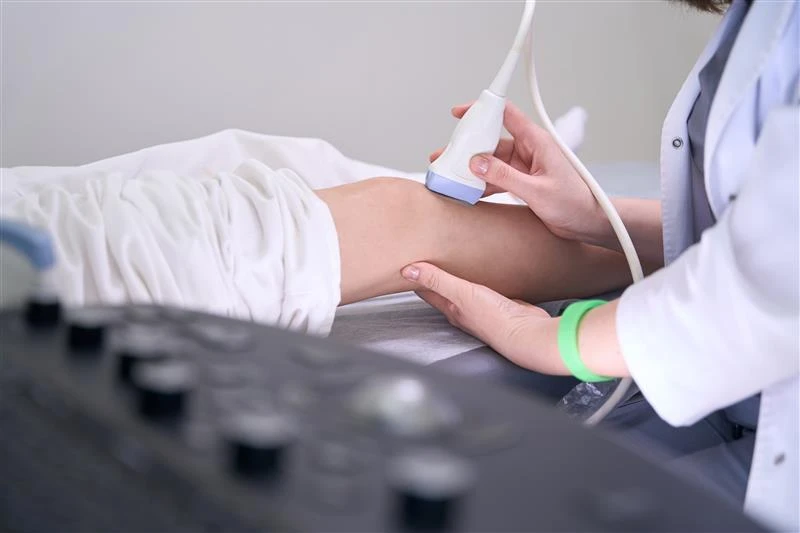
To understand the mechanism of ultrasound therapy, you must understand what the device looks like. So here you go.
The Machine: The main console is where the therapist sets the appropriate parameters (frequency, intensity, and mode) to generate the sound energy.
The Applicator (Wand): A handheld device with a smooth metal head that the therapist moves in gentle, circular motions over your skin.
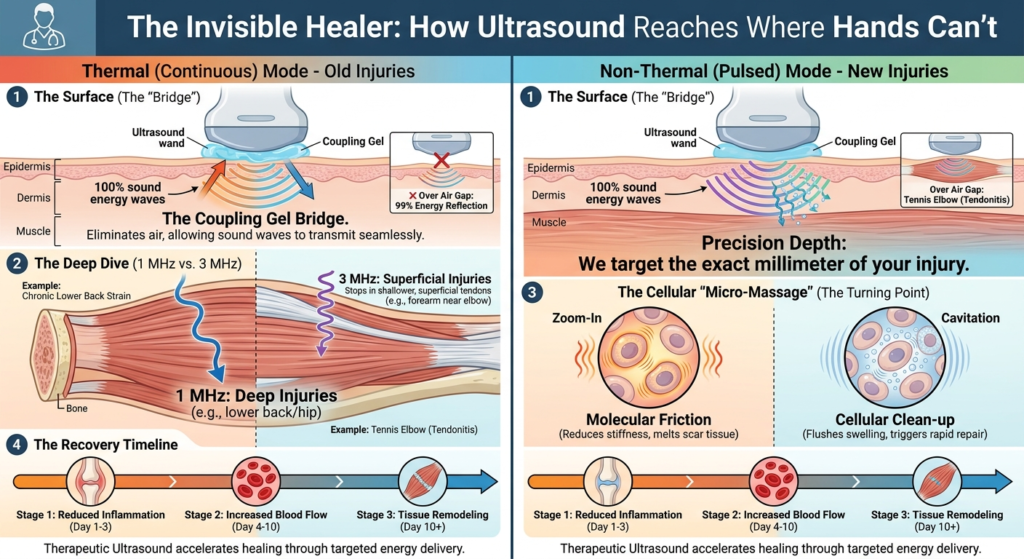
The Coupling Gel: The therapist applies a specialized gel to your skin. This gel acts as a crucial bridge, allowing the ultrasonic energy to transmit smoothly into the tissue without reflecting off the skin or overheating the applicator.
How Does Therapeutic Ultrasound Work?
The normal human hearing range is between 20 Hz and 20,000 Hz. Sound waves beyond this upper limit are classified as ultrasound. In physical therapy, the frequencies used are generally between 1.0 MHz and 3.0 MHz.
This specific frequency range is completely safe, painless, and requires no invasive procedures to penetrate affected tissues. Here is the step-by-step mechanism of what happens during a typical 5 to 10-minute session:
1. Production of High-frequency Sound Waves (the Piezoelectric Effect)
The ultrasound therapy device has an alternating electrical current source. This current is emitted from the source and transmitted to a transducer circuit inside the head of the applicator.
A Piezoelectric Crystal Is present behind the smooth metal surface of the applicator. When the electricity enters the transducer, it also hits this crystal. As a result, the Piezoelectric Crystal starts expanding and contracting at incredible speeds in its fixed position.
This rapid vibration creates mechanical pressure waves or high-frequency sound waves.
These sound waves vibrate at 1 MHz or 3 MHz. It depends on your therapist’s settings on the device. 1 MHz helps with deep injuries, like a hip or lower back strain. 3 MHz Treat superficial injuries like a risk sprain or tennis elbow.
2. Transmission of Sound Waves
For the sound waves to show their therapeutic effects, it needs to reach the correct location without any obstruction. This is where the role of gel comes into play.
Sound waves travel poorly through the air because air is a poor conductor of acoustic energy. If a therapist touched the metal head directly to your dry skin, 99% of the energy would reflect away.
The coupling gel acts as a “bridge.” It eliminates the air gap, allowing the sound waves to pass seamlessly from the transducer into your body’s tissues.
Thermal vs. Non-Thermal Biological Effects
Once the waves enter your tissue, they work in two distinct ways: Thermal and Non-Thermal.
Thermal Effects (Deep Tissue Heating)
In the ‘Continuous’ mode of the device, the sound waves are constant. This causes the molecules in your muscles, tendons, and ligaments to vibrate against one another, creating deep, localized heat. This heat production speeds up tissue repair and the healing process.
Non-Thermal Effects (Cellular Mechanics)
In “Pulsed Mode,” the energy comes in “bursts.” There is no heat buildup. This helps with fresh, acute injuries where heat might increase swelling.
What Is The Mechanism Of Healing By Ultrasound Therapy?
Research suggests that ultrasound therapy has a significant influence on healing tissues. Its effectiveness relies on the distinct mechanical processes that dictate how your tissues respond and recover during the therapy.
Thermal Effects (The Deep Heat)
Ultrasound therapy creates a slight warming effect by vibrating the molecules about their fixed positions. This high-frequency oscillation creates molecular friction, which in turn generates internal heat in the tissues and cells.
What Are the Benefits?
Reduces joint stiffness
Relieves pain
Enhances blood circulation
Relaxes muscle spasms
Non-Thermal Effects
Therapeutic ultrasound may not always be too intense to generate heat. Low-intensity sound waves can also accelerate cellular activity Through Cavitation and acoustic streaming.
What Are the Benefits?
Accelerates tissue repair
Removes cellular debris from the injury site
Reduces swelling
Allows nutrients to enter
Choosing between thermal and non-thermal settings depends entirely on the stage of your injury and your primary goal (pain relief vs. rapid repair).
| Injury Type | Type of healing | Why It Works |
| Chronic Lower Back Pain | Thermal (Deep Heat) | Relaxes long-standing muscle spasms and increases blood flow to “stiff” areas. |
| Acute Ankle Sprain | Non-Thermal (Cellular) | Reduces swelling and activates the “clean-up crew” without adding heat to an already inflamed area. |
| Tendonitis (e.g., Tennis Elbow) | Non-Thermal (Cellular) | Stimulates collagen production to repair microscopic tears in the tendon. |
| Joint Stiffness/Frozen Shoulder | Thermal (Deep Heat) | Softens collagen fibres to allow for a better range of motion during stretching. |
| Fresh Muscle Strain | Non-Thermal (Cellular) | Speeds up the initial inflammatory phase so you can move into the repair phase faster. |
| Old Scar Tissue | Thermal (Deep Heat) | Uses molecular friction to break down dense, fibrous tissue that limits movement. |
What Conditions Does It Treat?
Therapeutic ultrasound is customizable. Your therapist can adjust the intensity and mood depending on whether to treat surface-level comfort or deep-seated structural issues. Here are the most common conditions it addresses:
Ligament sprains
Muscle strains
Tendonitis
Breakdown of scar tissue
Chronic conditions like bursitis
Tissue injuries are unique for every individual, and so are their recovery needs. So doctors and physiotherapists assess your symptoms to diagnose the underlying cause and then recommend ultrasound therapy if applicable as a part of your treatment plan.
Conclusion
Therapeutic ultrasound offers a non-invasive alternative treatment for chronic stiffness, pain, and discomfort. It uses the healing powers of high-frequency sound waves to treat musculoskeletal conditions that cause pain and mobility problems. But is it the right treatment for your condition? To know that you must get your injury assessed by your registered physiotherapist at a multi-disciplinary clinic like Physiotherapy First and let them guide you through the rest of the process.