
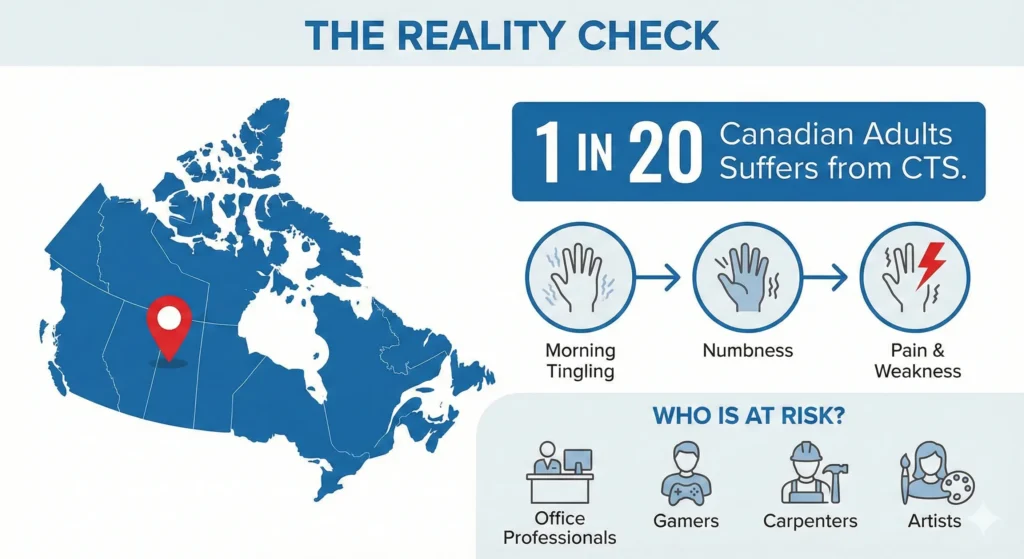
According to reports, about 1 in 20 adults suffers from carpal tunnel syndrome (CTS) in Canada. It usually starts subtly with a tingling sensation in your fingers as you wake up on a cold morning in Vancouver. However, the sensations transit to pain, numbness and limited movement in wrists and fingers, becoming a part of your daily life. Surgeries do not necessarily have to be the path to relief. Specific carpal tunnel exercises, lifestyle changes and ergonomic adjustments can also make a world of difference. This blog helps you understand carpal tunnel syndrome and how exercises can empower you to manage the condition effectively.
Note: Before we discuss the exercises, let’s set a firm ground rule. Always consult a healthcare professional first. If you are experiencing pain, tingling or numbness in your hands or wrists, your first call should be to your family doctor or a physiotherapist near you.
What is Carpal Tunnel Syndrome, Really?
Carpal tunnel syndrome is a painful disorder affecting the wrist and hand. It occurs when the median nerve in your wrist is compressed, primarily due to repeated movements of the hands and wrist, which puts excessive strain on the nerve. The condition is hence common in occupations like carpentry, typing or illustrating where one needs to move the hand constantly in the same motion.
Understanding the Anatomy of the Carpal Tunnel:
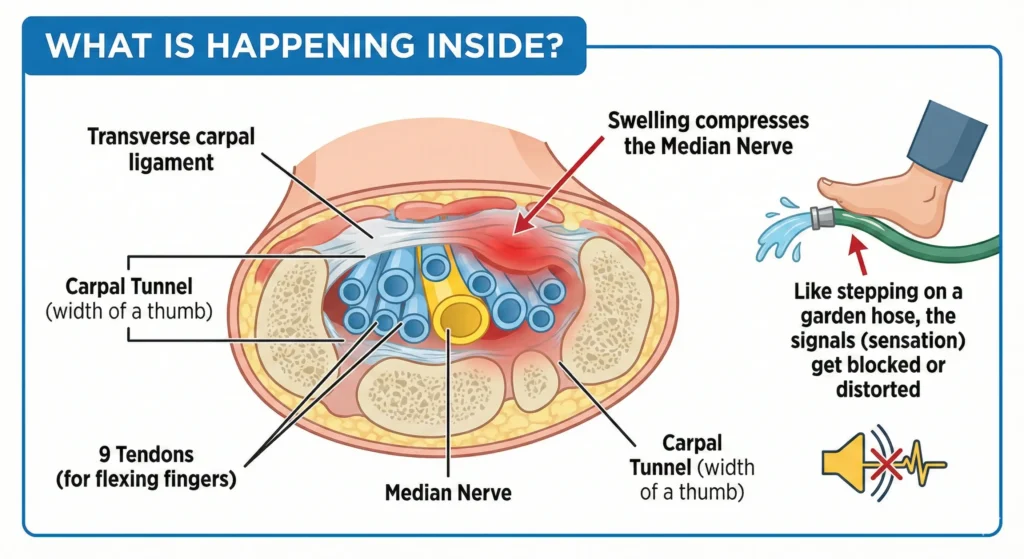
The carpal tunnel is a narrow passageway in your wrist, about the width of your thumb. It is formed by small wrist bones (carpal bones) on the bottom and sides. A strong, fibrous band of connective tissue forms the transverse carpal ligament, which forms the top of the tunnel.
The carpal tunnel is crucial for easy movement of the wrists and fingers. Let me explain why.
It allows nine tendons to pass through it. These nine tendons are responsible for flexing and bending your fingers and thumb.
Besides the tendons, it lets the median nerve pass through as well. The median nerve controls the sensations in your lower part of the thumb, index finger, middle finger and half of the ring finger.
What Causes Carpal Tunnel Syndrome (CTS)?
Okay, now that you know the structure of the carpal tunnel, let’s see what leads to the condition.
In the case of repetitive motions involving your wrists and fingers, the tendons or the tissues surrounding them become swollen and inflamed. This swelling puts pressure on the median nerve, which causes carpal tunnel syndrome.
Other factors can also cause the ‘compression’ of the median nerve, such as thyroid, diabetes or fractures.
What Are the Symptoms?
When the median nerve is compressed, the body sends signals trying to tell you might have CTS. Some common signs you may experience are:
- Tingling sensations in the fingers, especially in the thumb, index, and middle fingers.
- Numbness in the same fingers.
- Aching pain in the wrist, sometimes in the forearm or even up to the shoulder.
- Weakness in the hands.
The causes for CTS can differ from person to person. It is crucial that you consult a healthcare professional to have your symptoms checked and receive a proper, confirmed diagnosis.
Carpal tunnel syndrome is quite common in Canada among office professionals, construction workers, healthcare providers, programmers, and artists. The long winters also keep us inside for a sustained period of time, leading to more time on PCs, gaming consoles and mobile devices.
How Carpal Tunnel Exercises Help?
It might seem counterintuitive. If movement caused the problem in the first place, how can movement fix it?
We are not talking about any random movement. We are talking about specific, gentle and corrective movements under the guidance of a certified physical therapist. The goals are:
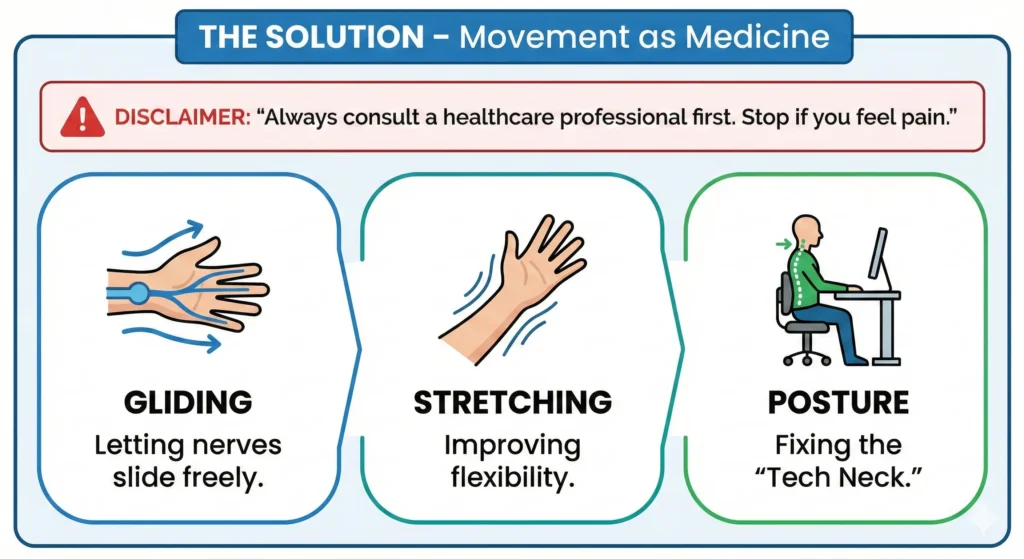
Enable the Smooth Gliding of Nerves and Tendons
The exercises for the carpal tunnel in the wrist encourage the median nerve and tendons to slide smoothly and freely within the carpal tunnel. This helps relieve the pressure off the median nerve while reducing its irritation as well.
Improve the Flexibility of the Tendons Passing through the Carpal Tunnel
The right stretching exercises help increase the flexibility of the muscles and tendons in the forearm that pass through the wrist. This can help reduce overall tension, letting the median nerve function without compression.
Reduce Pressure on the Median Nerve
The ultimate motive of carpal tunnel wrist exercises is to reduce the pressure on your median nerve. Exercises do so by “opening up” the carpal tunnel space, even if just slightly, to give the nerve some more room to do its job.
Correct Posture can Affect the Median Nerve
Poor posture in the shoulders and neck can often cause pain in the wrist. In that case, physiotherapists may teach posture correction exercises to correct ‘tech neck’ problems, which can have a direct, positive impact on your arms and hands.
List of Physiotherapy Exercises for Carpal Tunnel Syndrome
I have divided the exercises into categories, based on the exact source of your problem. Do talk to your physical therapist for a proper diagnosis and supervision about the exercises before you start them. Also, start slow and listen to your body.
Category 1: Nerve & Tendon Gliding Exercises
These exercises are highly specific for carpal tunnel syndrome. They are designed to gently mobilize the nerve and tendons.
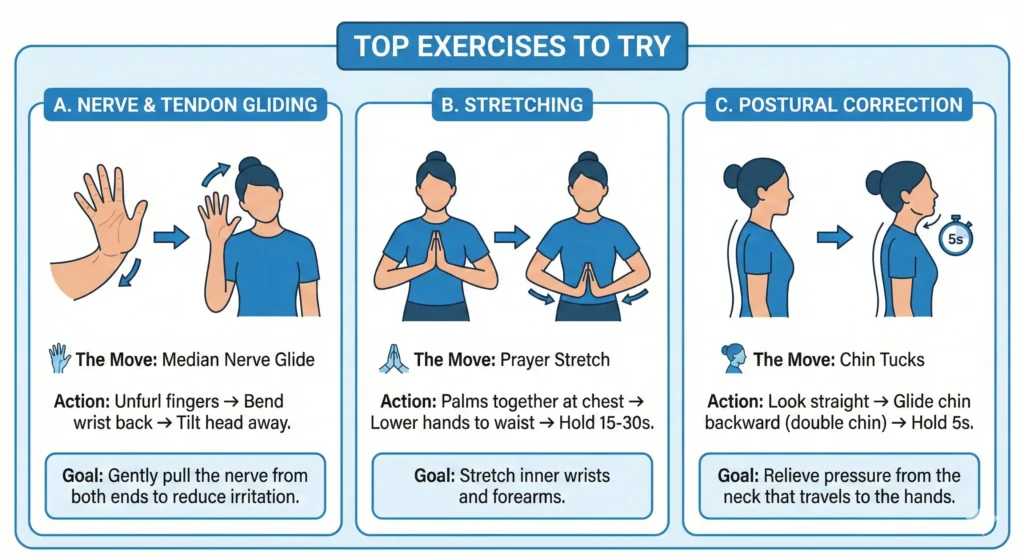
Median Nerve Glide
Goal: This exercise gently pulls the nerve from both ends, helping it glide.
How to do it?
Start: Make a loose fist with your thumb outside, palm facing you.
Step 1: Unfurl your fingers and thumb so they point straight up, keeping your wrist straight.
Step 2: Keeping your fingers straight, bend your wrist back (extend) so your palm faces forward.
Step 3: Keeping this position, gently tilt your head to the opposite side. You should feel a gentle “pull” or stretch, not pain.
Step 4: Return your head to the centre, then relax your wrist and fingers.
Reps: Repeat 5-10 times, very slowly and gently. Do this 1-2 times per day.
Tendon Gliding
Goal: This sequence moves the two main tendons in your forearm through their full range of motion.
How to do it?
Start (Position 1): Hold your hand up, fingers and thumb straight (“Open Hand”).
Position 2 (“Hook”): Bend your fingertips down to touch the top of your palm.
Position 3 (“Tabletop”): Keep your large knuckles (MCP joints) bent at 90 degrees, with your fingers straight out.
Position 4 (“Straight Fist”): Bend your fingers down from the tabletop position to touch your upper palm.
Position 5 (“Full Fist”): Make a full, tight (but not painful) fist.
Reps: Hold each position for 3-5 seconds. Go through the full sequence 5-10 times.
Category 2: Stretching Exercises
These exercises are recommended for the carpal tunnel to improve the flexibility of the forearm muscles, which helps maintain a range of motion in the associated joints. If done right, the stretching exercises keep the muscles flexible, allowing you to extend the wrists and hands all the way.
Wrist Flexion Stretch
Goal: This stretches the muscles on the inside of your forearm (the ones that close your hand).
How to do it?
Start: Straighten your arm.
Step 1: Bend your wrist so your palm faces down with the fingers pointing downwards.
Step 2: Now gently pull your hand towards your body. You will feel a stretch on the forearm.
Step 3: Hold the position for 10 seconds.
Reps: Repeat 5 times and then switch to the other arm.
Wrist Extension Stretch
Goal: This stretches the muscles on the top of your forearm (the ones that open your hand).
How to do it?
Start: Hold one arm straight out in front of you, palm facing down.
Action: Gently bend your wrist down (as if telling someone to “stop” with the back of your hand).
Assist: Use your other hand to gently press on the back of the down-bent hand, increasing the stretch.
Feel: You should feel a mild stretch on the top of your forearm.
Hold: Hold for 15-30 seconds.
Reps: Repeat 3-5 times on each arm.
Finger Stretch
Goal: This helps relieve tension in the small muscles and tendons of the fingers.
How to do it?
Start: Make a loose, relaxed fist.
Action: Slowly unfurl your fingers and spread them as wide apart as you comfortably can, like an open fan.
Feel: You should feel a gentle stretch in your fingers and thumb.
Hold: Hold the “fan” position for 5-10 seconds.
Reps: Repeat 5-10 times on each hand. This is an excellent, quick break you can do right at your desk.
Basic Wrist Stretch
Goal: This is a mobility exercise, not a deep stretch. It helps warm up the joint and encourages fluid movement.
How to do it?
Start: Hold one arm out, with your hand in a loose, relaxed fist.
Action: Slowly and gently rotate your wrist in a circular motion. Make the circles small and controlled.
Feel: This should feel easy and smooth. If it clicks or hurts, make the circle even smaller or stop.
Reps: Do 10 circles in one direction, then 10 circles in the other direction. Repeat on the other wrist.
Wrist Stretch with Weights
CAUTION: This is a more advanced stretch. If you have active pain or severe symptoms, skip this exercise. Always start with NO weight. Use a weight only if your physiotherapist instructs.
How to do it? (using a light weight)
Part 1 (Flexor Stretch): Sit at a table. Hold your lightweight. Rest your forearm on the table with your palm facing up and your hand/wrist just off the edge. Let the weight gently pull your hand down towards the floor, stretching the inside of your forearm. Hold for 15-20 seconds.
Part 2 (Extensor Stretch): In the same position, turn your hand over so your palm faces down. Let the weight gently pull your hand down, stretching the top of your forearm. Hold for 15-20 seconds.
Reps: Perform 1-2 sets on each arm, only if it feels gentle and relieving.
Prayer Stretch
Goal:
How to do it?
Start: Stand or sit. Place your palms together in front of your chest, as if in prayer.
Action: Slowly lower your hands down towards your waistline, keeping your palms pressed firmly together.
Feel: You should feel a gentle stretch in your inner wrists and forearms.
Hold: Hold for 15-30 seconds. Do not bounce.
Reps: Repeat 3-5 times.
Category 3: Postural Exercises
Your nerves run from your spine to different parts of the body, including the fingertips. So, a problem in your neck, shoulders and spine can create problems in your wrists. If the physio finds out that the cause of your CTS has to do with a postural problem, they may recommend postural correction exercises to fix it.
Chin Tucks
Goal: This helps deal with “tech neck” and relieves pressure at the top of the nerve chain.
How to do it?
Start: Sit or stand tall, looking straight ahead.
Action: Gently glide your chin straight back, as if making a double chin. Think of pulling your head back on its “shelf,” not tilting it down.
Feel: You’ll feel a stretch at the back of your neck.
Hold: Hold for 5 seconds.
Reps: Repeat 10 times. Do this several times throughout the day.
Shoulder Blade Squeezes
Goal: This prevents slouching by pulling back the shoulders and opening your chest.
How to do it?
Start: Sit or stand tall, arms at your sides.
Action: Gently squeeze your shoulder blades together, as if trying to hold a pencil between them.
Feel: You’ll feel your chest open. Don’t shrug your shoulders up to your ears!
Hold: Hold for 5-10 seconds.
Reps: Repeat 10-15 times.
Doorway Pectoral Stretch
Goal: It improves shoulder and neck mobility by lengthening chest muscles, which tend to tighten the chest common from desk work.
How to do it?
Start: Stand in a doorway. Place your forearms on the doorframe on either side, with your elbows at or just below shoulder height.
Action: Step forward with one foot, gently leaning your body through the doorway until you feel a good stretch across your chest.
Hold: Hold for 20-30 seconds.
Reps: Repeat 2-3 times.
What’s Beyond Exercises for Carpal Tunnel Syndrome Management?
Carpal tunnel exercises are just one piece of the puzzle. You can take several other measures consciously to manage the condition or prevent it from recurring.
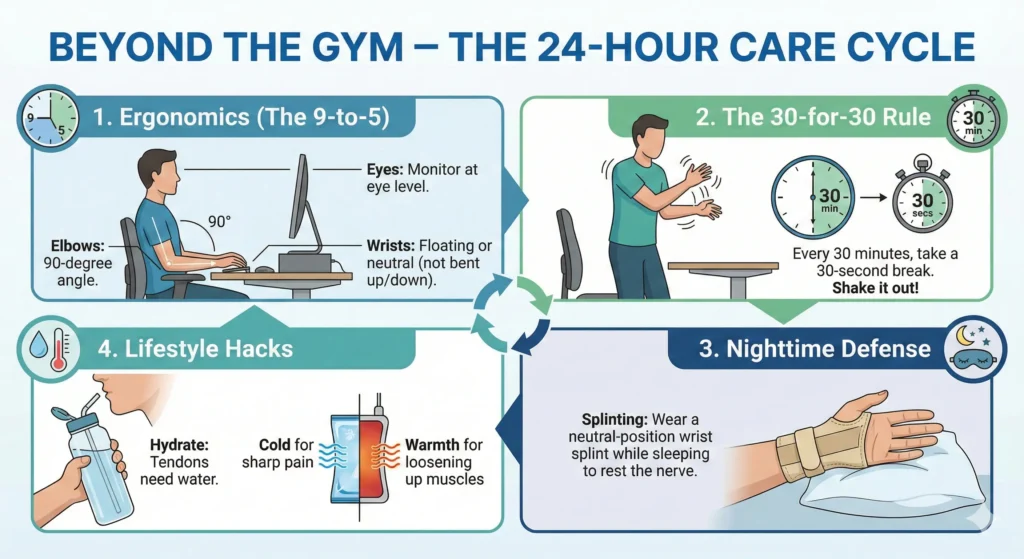
Proper Ergonomic Setup
For the 8+ hours a day you’re at your desk, your setup is everything.
Chair: Your feet should be flat on the floor (use a footrest if needed).
Monitor: The top of your screen should be at or just below eye level.
Keyboard: Position it so your elbows are at a 90-degree angle, and your wrists are straight, not bent up or down. Your wrists should “float” or use a gel rest, not rest on the hard edge of the desk.
Mouse: Use a vertical mouse or a trackball if a standard mouse causes you to bend your wrist.
CCOHS Guideline: Check the Canadian Centre for Occupational Health and Safety (CCOHS) website. They have excellent, free resources and checklists for office ergonomics.
Take Micro-Breaks
Your hands need a break. Set a timer. Follow the 30-for-30 Rule: Every 30 minutes, take a 30-second break. Shake out your hands. Do a few wrist stretches. Roll your shoulders. This prevents cumulative strain.
Night-Time Splinting
This is a game-changer for many. A neutral-position wrist splint keeps your wrist from bending while you sleep. This “rests” the nerve and tunnel, allowing inflammation to decrease. It’s often the single most effective non-surgical treatment for relieving nighttime symptoms.
Lifestyle & Other Tools
Hydration: Your tendons and nerves need water. Stay hydrated.
Anti-Inflammatories: Over-the-counter medications can help reduce inflammation and pain.
Always check with your pharmacist or doctor to ensure they are safe for you.
Hot & Cold: A cold pack can help numb acute pain and reduce swelling. A warm (not hot) pack or soaking in warm water before doing your exercises can help loosen up the muscles.
Activity Modification: Pay attention to what causes the flare-up. Can you use a different tool? Hold your phone in your other hand? Use voice-to-text?
A “physio” is your exercise expert. They can give you a personalized exercise plan, use manual therapy to mobilize your wrist and neck, and use modalities like ultrasound or acupuncture.
Conclusion
Living with carpal tunnel syndrome can feel frustrating and isolating. Your hands, after all, are your connection to the world. We use them to build, create and communicate. The problem is that carpal tunnel syndrome is a common condition that not only causes pain but also limits the movement of your wrists and fingers. The good news is you have options to manage the condition. By understanding the “why” behind your symptoms and committing to a “what” that includes gentle, consistent exercise, smart ergonomics, and proactive self-care, you can reclaim control. The specific carpal tunnel exercises, supervised by your therapist or doctor, can help you resume the activities which otherwise feel difficult due to the condition.
Be patient with yourself. Consult a healthcare professional. Listen to your body. Stop if you feel any type of pain.